


New York is not a forgiving market.
If you’re a vascular surgeon in NYC, you can have the credentials, the outcomes, the staff, the whole thing… and still get undercut online by whoever Google decides is “most obvious” to recommend that day.
Patients don’t run deep research projects when they’re worried about pain, swelling, circulation issues, or a referral they don’t fully understand. They search, scan, tap a couple options, and call.
That’s why local SEO for a medical practice isn’t about clever marketing. but about removing uncertainty for Google and for the patient.
This case study shows what changed over roughly three months for the search term “vascular surgeon New York” and related “near me” searches: visibility improved across the city, and the business metrics inside the Google Business Profile moved in the same direction.
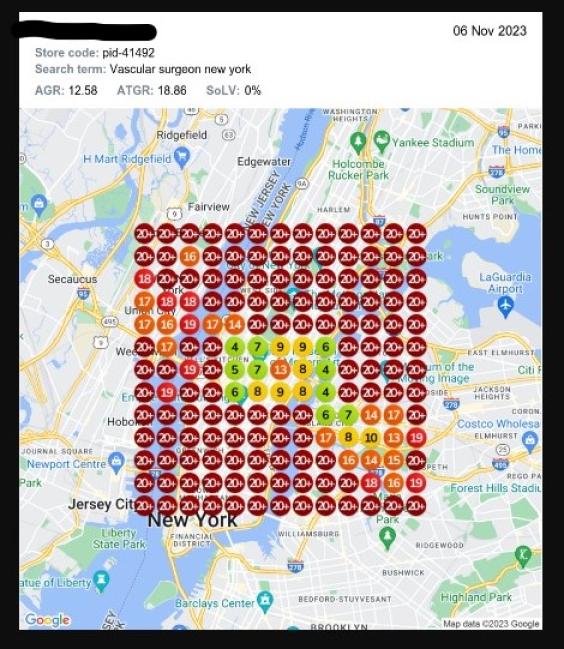
November: most of the grid is 20+. In Google Maps, that’s not “page two.” That’s simply not being considered.
Where the practice started: present online, absent where it matters
The practice wasn’t brand new. This wasn’t a “we don’t have a website” situation. It had the normal baseline most clinics have:
- a functioning site
- a Google Business Profile
- existing reviews
- real services being delivered every day
But when we pulled the geo-grid around Manhattan and surrounding areas for “vascular surgeon New York”, it explained the real issue immediately:
Google wasn’t giving the listing broad, reliable visibility. Across large parts of the city, the practice showed as 20+.
At the start, the scan showed:
- AGR: 12.58
- ATGR: 18.86
- SoLV: 0%
You can dress that up in a hundred ways, but operationally it means one thing: there are a lot of patients in New York who never even saw the practice as an option.
What we looked at in the local SEO audit
Medical is a higher bar category. Between reputation, proximity, and credibility signals, you don’t get rewarded for being vague.
We ran a local SEO audit around the two assets that decide most outcomes in Maps:
1) Google Business Profile optimization (relevance + activity + consistency)
When a GBP is “fine,” it often still underperforms. In practice, that usually means:
- categories and services aren’t tight enough to match how patients search
- the listing doesn’t look active week-to-week
- trust signals exist, but there’s no momentum behind them
- the profile isn’t reinforcing what the website says (or vice versa)
This isn’t about tricks. It’s about giving Google fewer reasons to hesitate.
2) Website support for intent (patient searches are specific)
For queries like vascular surgeon New York and “near me” variants, Google tends to reward practices that make the relevance and credibility obvious:
- what conditions are treated
- what procedures are offered (written responsibly)
- location context and accessibility
- proof and reassurance placed where patients actually decide
Many practice sites read like brochures. Patients don’t read brochures when they’re anxious. They scan for signals: credibility, clarity, safety, next step.
What we changed over 90 days
We kept the work practical: strengthen the map signals, strengthen the website support, then make sure visibility turns into action.
Phase 1: tighten relevance and remove ambiguity (Weeks 1–3)
- GBP structure tightened for the core terms patients use
- consistency signals cleaned up where they mattered
- measurement put in place so we weren’t guessing later
Phase 2: build supporting intent pages (Weeks 3–8)
- strengthened pages tied to “money searches” (not random blog posting)
- improved internal structure so authority flowed to the pages that support Maps relevance
- added clarity that reduces patient hesitation (what to expect, what happens next, etc.)
Phase 3: trust and conversion (Weeks 6–12)
- improved proof placement and conversion path
- strengthened the “confidence stack” without sounding salesy
- ensured the listing + site told the same story, consistently
If you’ve ever watched local SEO done poorly, it usually fails because everything is scattered: one vendor “does citations,” one vendor “writes blogs,” someone else “touches the GBP,” and none of it lines up. Here, we lined it up.
The first sign it’s working: GBP actions start moving
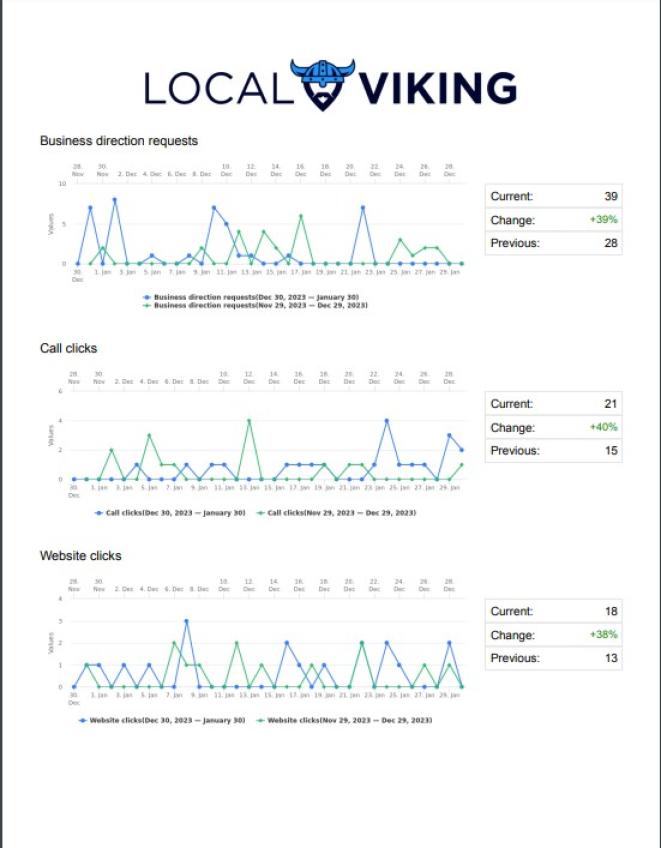
Before rankings look dramatic, you often see movement in the practical metrics: people clicking to call, asking for directions, clicking the website.
These were the Google Business Profile changes (Local Viking report), comparing Nov 29–Dec 29 to Dec 30–Jan 30:
- Business direction requests: +39% (from 28 to 39)
- Call clicks: +40% (from 15 to 21)
- Website clicks: +38% (from 13 to 18)
And impressions were moving too:
- Desktop maps impressions: +33% (from 6 to 8)
- Desktop search impressions: +16% (from 245 to 284)
- Mobile maps impressions: +27% (from 51 to 65)
- Mobile search impressions: +26% (from 441 to 557)
Those are small absolute numbers in places (which is normal for a specialty query), but directionally they matter because they show a practice becoming more visible and more chosen in the moments that lead to patient inquiries.
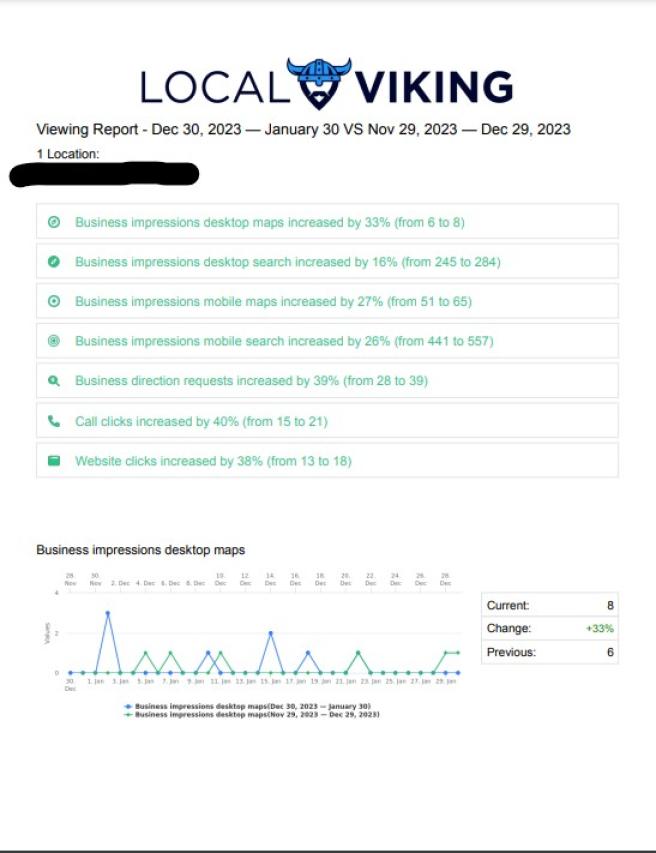
GBP actions moved first: calls, directions, and website clicks. That’s usually the earliest indicator that visibility is turning into patient intent.
A clean month-over-month lift across Maps and Search impressions. In NYC medical, you want steady compounding, not spikes.
Maps visibility: the grid told a different story by February
This is where the change becomes obvious even to someone who doesn’t care about SEO.
The February geo-grid scan for “vascular surgeon New York” shows the center of the city shifting into stronger positions, with significantly more coverage inside the areas that actually matter.
The scan improved to:
- AGR: 8.66 (down from 12.58)
- ATGR: 9.53 (down from 18.86)
- SoLV: 16% (up from 0%)
In plain language: the practice didn’t “rank for a keyword.” It gained location-based visibility across New York that it simply didn’t have before.
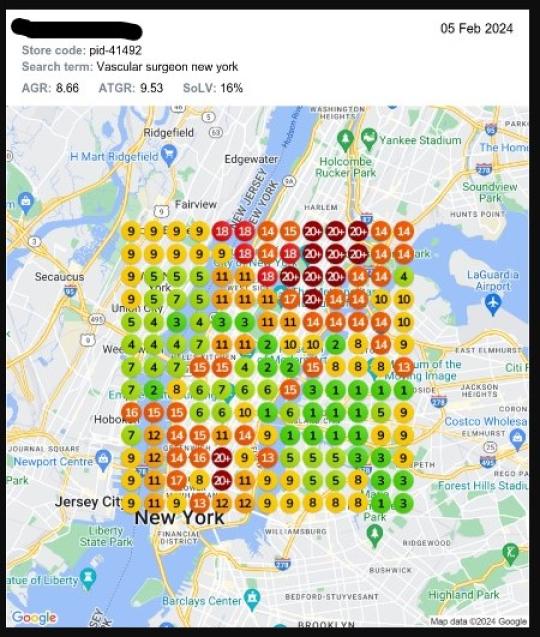
February 2024: the grid is no longer dominated by 20+. More top positions appear in the areas where patients are searching.
Why it worked (and why local SEO often doesn’t)
A lot of local SEO campaigns fail in NYC because they’re built like a content project. Medical local SEO behaves differently.
What matters most is alignment:
- The GBP has to communicate relevance and credibility clearly.
- The website has to support that story with intent pages that match how patients search.
- Trust has to be placed where the decision is made: on the listing and on the landing page, not hidden behind menus.
When those signals line up, Google is more confident showing the practice. When Google is more confident, patient actions start moving.
There wasn’t a single “secret trick” here. It was disciplined execution on the signals that actually decide map pack rankings.
What this means for other practices in New York
If you’re a specialist and your referral network is solid but your inbound is inconsistent, it’s usually not because the market is dead. It’s because your visibility is thin in the places where patients make quick choices.
The fastest things to sanity-check:
- Does your Google Business Profile clearly match the search terms you want to win?
- Do you have pages that match patient intent, or one generic services page?
- Do your trust signals show up immediately (reviews, credibility, clarity), or are they buried?
- Are you tracking calls, direction requests, and website clicks from GBP so you can see momentum?
Local SEO doesn’t need to be mysterious. It just needs to be coherent.
If you want, we can run the same visibility diagnostic for your practice and show you:
- where you’re strong in Maps
- where you’re invisible
- what’s stopping broader coverage
- what the fastest “confidence fixes” would be